
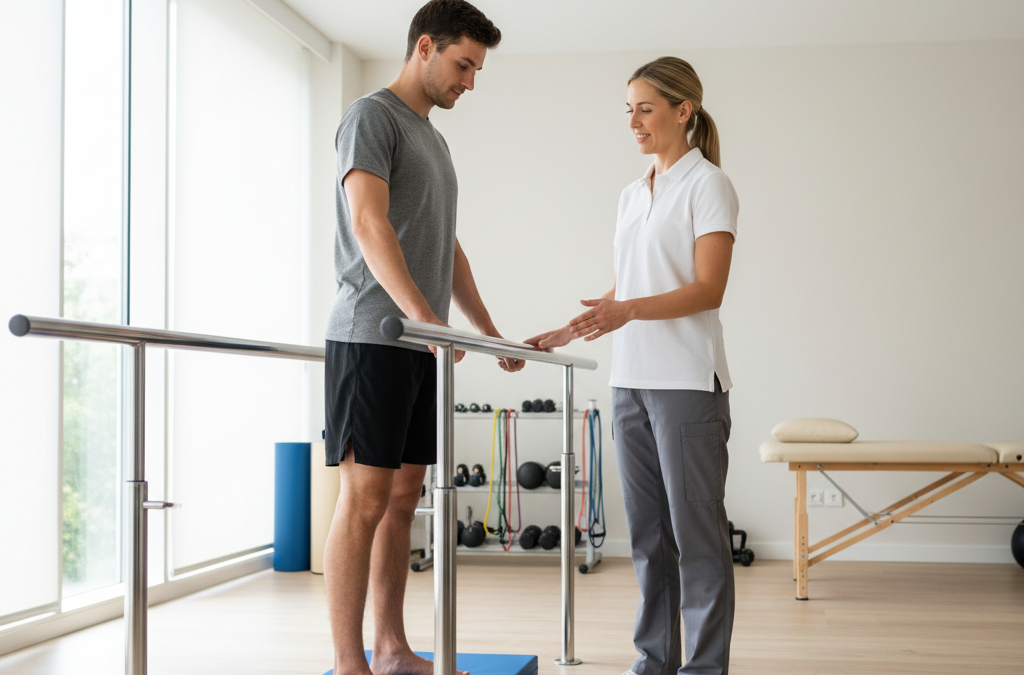
Vestibular therapy exercises for balance are targeted movements that retrain your inner ear, eyes, and body to steady your gaze and posture. The right plan restores stability by improving the vestibulo-ocular reflex (VOR), reducing dizziness through habituation, and strengthening balance strategies so you can walk, turn, and bend with confidence.
By Whitby Physiotherapy & Sports Rehab • Last updated: April 8, 2026
Above the Fold: Hook, Summary, and Table of Contents
Use this practical guide to select safe, effective vestibular therapy exercises for balance and plan your first four weeks. You’ll get step-by-step drills, progressions, safety rules, and when to see a vestibular physiotherapist in Whitby for one-on-one help at 198 Des Newman Blvd.
Quick Summary
- Goal: Regain steadiness by retraining your inner ear (vestibular system), eyes, and postural muscles.
- Core methods: Gaze stabilization (VOR), habituation (desensitization), and static/dynamic balance training.
- Timeframe: Many people notice improvements in 2–4 weeks with daily practice; more complex cases can take 8–12 weeks.
- Safety first: Start near a counter or rail, practice within your symptom threshold, and log progress.
- Local help: Our vestibular clinicians assess dizziness, BPPV, post-concussion issues, and balance disorders.
Quick Answer
Vestibular therapy exercises for balance retrain your inner ear and eye reflexes so you feel steady during daily activities. At our clinic on 198 Des Newman Blvd in Whitby, we tailor VOR, habituation, and balance drills to your triggers and goals, then progress weekly as your symptoms calm and your stability improves.
Local Tips
- Tip 1: If you get lightheaded outdoors, practice your early drills along a hallway at home before trying uneven paths near 198 Des Newman Blvd. Add outdoor practice only after you’re steady indoors.
- Tip 2: Winter in Whitby can mean icy sidewalks. Prioritize indoor balance work and footwear with good traction; add outdoor walking drills on clear afternoons when conditions are stable.
- Tip 3: Post-concussion dizziness often spikes with busy visuals. Wear a cap or use quieter aisles at first, then gradually expose yourself—exactly how we pace progressions in clinic-based vestibular rehab.
IMPORTANT: If symptoms surge or you’ve had recent falls, book a vestibular assessment before advancing exercises.
What Are Vestibular Therapy Exercises?
Vestibular therapy exercises are customized drills that improve your inner ear–eye reflexes, reduce motion sensitivity, and restore balance. Programs combine gaze stabilization, habituation, and balance retraining to cut dizziness and prevent falls. Plans are individualized after assessment to match triggers, diagnosis, and daily goals.
- Definition: A set of evidence-based movements that target the vestibular system (inner ear), visual tracking, and proprioception to keep you stable while your head and body move.
- Main components:
- Gaze stabilization (VOR): Trains eyes to stay on target while the head moves.
- Habituation: Gradually exposes you to movements that provoke symptoms to desensitize your system.
- Balance retraining: Challenges stance and walking on stable/unstable surfaces to improve postural strategies.
- Who benefits:
- People with dizziness or vertigo (including BPPV after canalith repositioning).
- Patients with post-concussion dizziness and visual motion sensitivity.
- Older adults with unsteadiness or a recent near-fall.
- Athletes returning to sport who feel “off” with quick turns or head checks.
- Expected timeline: Many see functional gains in 2–4 weeks of consistent practice; complex presentations may need 8–12+ weeks.
One in four adults age 65+ experiences a fall each year in North America—a leading cause of injury. Targeted balance training meaningfully reduces fall risk when done regularly and progressed safely.
Why Vestibular Therapy Exercises for Balance Matter
Balance problems limit walking, driving, work, and sport. Vestibular therapy exercises reduce dizziness, sharpen gaze, and strengthen postural control to restore daily function. They’re effective for age-related imbalance, post-concussion dizziness, and vertigo—helping you move confidently without depending on visual “guardrails.”
- Daily-life impact:
- Stairs, grocery aisles, and busy screens can trigger veering or nausea.
- Confidence drops; people avoid movement and lose conditioning.
- Driving or returning to work feels unsafe without targeted rehab.
- Functional outcomes we aim for:
- Keep your eyes locked on a target while turning your head (VOR control).
- Walk straight, change direction, and look around without imbalance.
- Handle visual motion (malls, traffic) with fewer symptoms.
- Who should prioritize rehab now:
- Frequent “spells” of dizziness, veering, or blurred vision on head turns.
- Recent fall or near-fall, especially with uneven ground or darkness.
- Post-concussion symptoms beyond 10–14 days.
For personalized testing and exercise selection, our clinicians provide dedicated vestibular physiotherapy in Whitby. If your dizziness followed a head injury, our concussion physiotherapy program integrates graded vestibular, ocular, and exertion rehab.
How Vestibular Balance Rehab Works
Vestibular rehab restores stability by recalibrating your balance “inputs.” It strengthens the vestibulo-ocular reflex for clear vision during head motion, desensitizes motion triggers, and upgrades postural strategies through progressive stance and gait drills. The system adapts with frequent, symptom-limited practice.
- The three balance inputs:
- Vestibular (inner ear): Senses head acceleration/position.
- Visual: Eyes track space and motion.
- Somatosensory: Feet, joints, and muscles report surface and position.
- Core mechanism—VOR (vestibulo-ocular reflex):
- Maintains a stable gaze while your head moves.
- Weak VOR = blurring on turns, veering when you look around.
- Gaze stabilization drills (X1, X2 viewing) directly train this.
- Desensitization via habituation:
- Short, repeated exposures teach your brain that provocative movements are safe.
- Symptoms should rise mildly, settle within minutes, then improve over days.
- Postural strategy upgrades:
- Static stances (feet together, semi-tandem, tandem, single-leg).
- Dynamic gait (head turns, dual-task, obstacles) mimics real life.
Practice frequency matters. Short, daily bouts (5–10 minutes, 2–4 times/day) often outperform one long session because they drive faster neural adaptation.
Types of Vestibular Therapy: Methods and Approaches
Most programs mix gaze stabilization (VOR), habituation, and balance retraining. Start on firm ground, add foam or narrow stance, then introduce head turns, walking, and dual-tasking. Repositioning maneuvers (like Epley) address BPPV specifically and are best performed after professional assessment.
Gaze Stabilization (VOR) Drills
- X1 Viewing:
- Hold a letter-sized target at eye level.
- Move your head horizontally; keep the target clear.
- 30–60 seconds, 2–4 sets, 2–3 times/day.
- X2 Viewing:
- Move your head and the target in opposite directions.
- Harder; add only when X1 is steady.
- 20–45 seconds, 2–3 sets.
- Progressions: Increase speed, add vertical head turns, perform sitting → standing → walking, dim the lights slightly, then add background motion.
Habituation (Desensitization) Drills
- Choose 2–3 triggers: Looking up, rolling in bed, quick bends, busy visuals.
- Repeat each trigger: 5–10 times, with short rests, aiming for mild and brief symptom rise that resolves in < 15 minutes.
- Examples: Sit-to-supine-to-sit reps; repeated head turns while seated; eye–head coordination against a patterned wall.
Balance Retraining
- Static stances (30–45 seconds each):
- Feet together → semi-tandem → tandem → single-leg.
- Eyes open → eyes closed (with spotter).
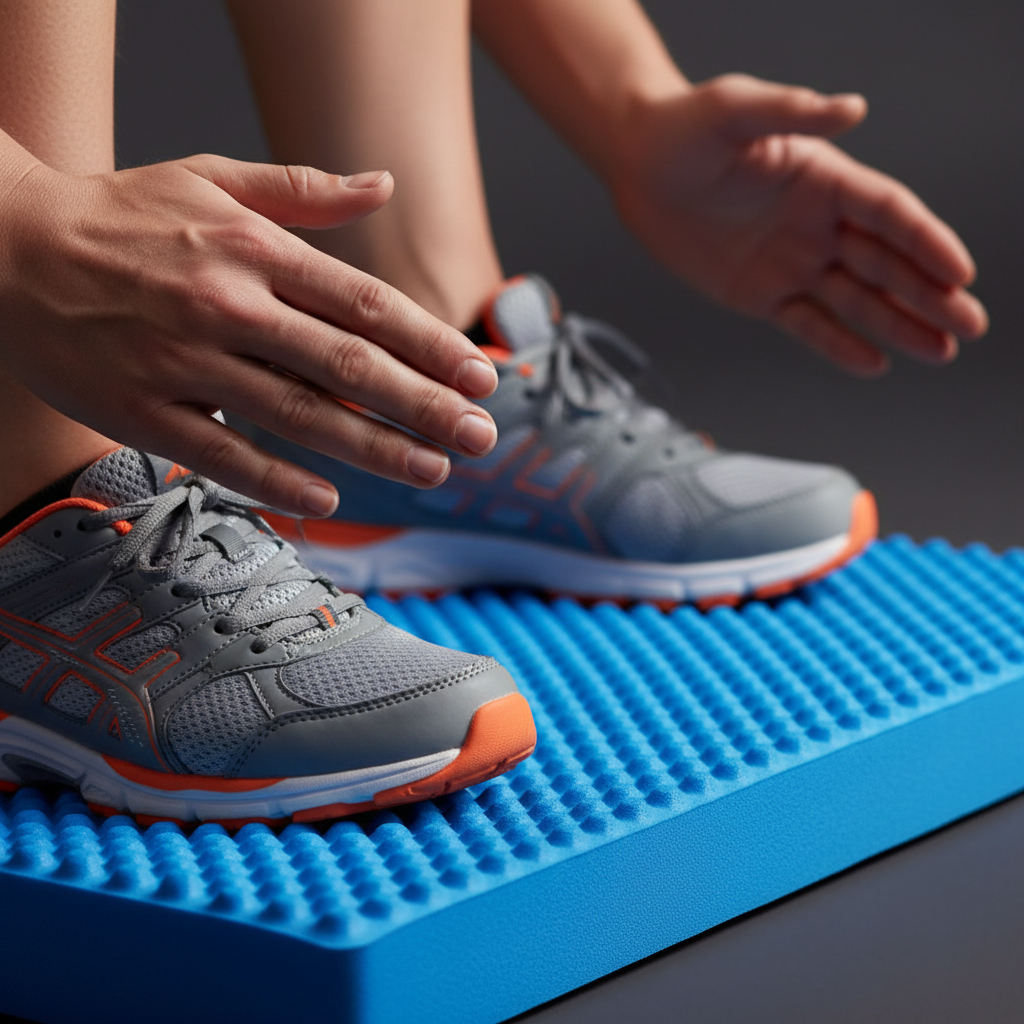
- Firm surface → foam pad.
- Dynamic gait:
- Walk with horizontal head turns every 2–3 steps.
- Figure-8 walking around two cones or chairs.
- Dual-task (count backward, carry a cup of water).
- Real-world add-ons: Curb steps, hallway obstacles, gentle turns with groceries.
BPPV Note
- Repositioning maneuvers (e.g., Epley): Highly effective for canalithiasis but diagnosis-specific; best performed and taught after a vestibular assessment.
- After successful maneuvers: Add VOR and balance drills to consolidate stability and reduce recurrence risk.
Method Comparison at a Glance
| Method | Primary Purpose | When to Use | Coaching Cues |
|---|---|---|---|
| Gaze stabilization (X1/X2) | Sharpen VOR; clear vision with head motion | Blurred vision while turning/walking | Small head range, steady target, build speed gradually |
| Habituation | Reduce motion sensitivity | Repeated triggers (e.g., bending, rolling) | Short exposures, brief symptom rise, quick recovery |
| Static balance | Improve stance control | Unsteadiness while standing | Neutral posture, light finger support if needed |
| Dynamic gait | Stability during movement | Veering, turns, community walking | Look ahead, rhythmic steps, add head turns later |
Best Practices, Safety, and 4–8 Week Progressions
Start easy, increase challenge weekly, and stop short of severe or lingering symptoms. Practice short bouts daily and track your response. Add speed, stance difficulty, and dual-tasking as you improve. Seek assessment if symptoms spike, vision blacks out, or you’ve fallen recently.
Safety Rules That Protect Progress
- Use a support: Practice near a counter, rail, or inside a doorway.
- Symptom threshold: Mild and brief (resolves in minutes) is okay; sharp or lasting symptoms mean you should stop and regress.
- Vision first: Wear your prescription lenses; avoid eyes-closed work until you’re steady.
- Environment: Clear clutter, secure pets, good lighting.
- Red flags: Sudden hearing loss, new severe headache, neurological changes—seek medical care.
Suggested Weekly Plan (Adapt to Your Tolerance)
- Weeks 1–2:
- X1 viewing seated → standing; 30–45 seconds, 2–3 sets.
- Static stance: feet together → semi-tandem (eyes open).
- Short habituation exposures to 1–2 main triggers.
- Weeks 3–4:
- X1 faster or X2 light, add vertical head turns.
- Tandem stance; introduce foam pad or narrow base.
- Start dynamic gait with slow head turns.
- Weeks 5–6:
- Walking X1/X2 with a stable hallway target.
- Single-leg stance holds; step-overs and direction changes.
- Dual-task gait (counting, naming) to challenge attention.
- Weeks 7–8:
- Variable surfaces and lighting; light background motion.
- Community tasks: curbs, mild crowd exposure, parking lots.
- Sport/occupation-specific drills (e.g., head checks for drivers).
Document your progress in a simple log. Consistent practice—brief, frequent sets—drives adaptation and reduces flare-ups compared with occasional, intense sessions.
If you struggle with visual motion sensitivity or post-concussion issues, this section pairs well with our practical guide on symptoms in community settings discussed in our dizzy spells and vertigo article.
Tools and Simple Home Resources
You can start with everyday items: a chair, hallway wall target, foam pad, and a metronome app. Add cones, step markers, and a logbook. Clinical sessions layer in diagnostic testing and supervised progressions tailored to your triggers and goals.
- At-home essentials:
- Printed letter or sticker as a gaze target at eye level.
- Chair or countertop for light support.
- Foam pad or folded yoga mat for stance challenges.
- Metronome app to pace VOR speed (start 60–80 bpm).
- Phone notes/logbook to track sets, symptoms, triggers.
- Clinic-based advantages:
- Objective tests of eye movements, positional vertigo, and balance strategies.
- Diagnosis-specific plans (e.g., post-concussion, BPPV, unilateral hypofunction).
- Coaching on symptom thresholds, progressions, and return-to-work/sport.
- Integrated care under one roof: If neck tension or headaches limit progress, our team coordinates physiotherapy, massage, chiropractic, and when indicated, acupuncture—streamlining your plan.
Not sure where to begin? Our vestibular rehabilitation service starts with a detailed assessment so your home program fits your specific triggers and daily goals.

Free Progression Checklist (DIY):
- Can you keep the target clear for 45–60 seconds at your current speed?
- Do symptoms settle within 10–15 minutes after practice?
- Is your stance hold steady for 30–45 seconds on the current surface?
- If yes to all, progress one variable (speed, surface, stance, dual-task).
Need tailored progression? Book a one-on-one vestibular assessment at our Whitby clinic. Direct insurance billing is available with many plans, and we coordinate MVA/WSIB claims.
Case Studies and Local Examples
Targeted vestibular programs pair the right drill with the right trigger. In Whitby, we routinely see faster improvement when VOR work, habituation, and balance challenges are sequenced weekly and supported by coordinated care for neck pain or headaches.
- Post-concussion adult (office worker):
- Problem: Visual motion sensitivity and blurry vision with head turns in open-plan offices.
- Plan: X1 viewing at 70–90 bpm, graded screen exposure, and tandem stance on firm → foam.
- Result: Fewer episodes in 3 weeks; able to attend longer meetings with fewer breaks.
- Older adult after near-fall on stairs:
- Problem: Unsteadiness stepping down and turning to look behind.
- Plan: Static stance progressions with hand support, gentle head-turn walking in hallway, step-down practice.
- Result: Measurable confidence gain by week 4; resumed daily walks.
- Recreational hockey player:
- Problem: Veering during quick head checks after a mild concussion.
- Plan: Walking X1/X2, figure-8 gait with head turns, dual-task stickhandling drills off-ice.
- Result: Smoother direction changes by week 5; began non-contact practice.
If your symptoms started after a head injury, review our local post-concussion vestibular guide for pacing ideas, then tailor with our team as needed.
FAQ: Vestibular Therapy and Balance
Most people start with short, daily VOR and balance drills, then add habituation for triggers. If symptoms spike or you’re unsure of the cause, a vestibular assessment aligns your plan with a proper diagnosis and clear progressions.
- How do I know which exercise to start with?
Begin with X1 viewing (gaze stabilization) and an easy static stance you can hold for 30 seconds. If rolling in bed or looking up triggers symptoms, add light habituation. If your dizziness is positional (like BPPV), you’ll need a specific maneuver taught after assessment. - How often should I practice?
Brief, frequent sessions work best—5–10 minutes, 2–4 times daily. Stop short of severe or lingering symptoms. Log your response and progress one variable per week if recovery is quick and stable. - When should I see a vestibular physiotherapist?
If you’ve fallen or nearly fallen, symptoms are severe, you’re not improving after 2–3 weeks, or triggers are unclear, book an assessment. Professional testing identifies the cause and calibrates your program, often speeding results. - Is it safe to exercise if I feel dizzy?
Mild, brief symptoms during training are expected in habituation work. Severe or long-lasting increases are not. Use supports, reduce intensity, and consult a clinician if symptoms escalate or new red flags appear. - Can neck problems affect my balance?
Yes. Neck stiffness and cervicogenic dizziness can amplify imbalance. Coordinated care—manual therapy, mobility drills, and posture work—alongside vestibular training often accelerates improvement.
Conclusion: Build Stability, One Repetition at a Time
Consistent, well-paced practice recalibrates your balance system. Start with VOR and stable stances, add triggers as tolerable, and progress weekly. If symptoms persist or you’ve had a recent fall, a comprehensive assessment provides a faster, safer road back to steady movement.
Key Takeaways
- Vestibular therapy exercises for balance target VOR control, motion desensitization, and stance/gait stability.
- Short, frequent sessions drive adaptation without overwhelming your system.
- Progress one variable at a time (speed, surface, stance, dual-task).
- Seek assessment for severe, unclear, or persistent symptoms.
Action Steps
- Set up a safe space (chair, counter, wall target, foam pad).
- Perform X1 viewing and a static stance you can hold for 30–45 seconds.
- Add one habituation trigger; keep exposures short and recover fully.
- Advance weekly if symptoms remain mild and brief.
- Book a vestibular assessment if you’re not improving in 2–3 weeks.
Ready to feel steady again? Schedule a vestibular assessment at Whitby Physiotherapy & Sports Rehab, 198 Des Newman Blvd. Our integrated team can coordinate physiotherapy, concussion rehab, and balance training under one roof.
Related Articles
Explore more topics that complement your balance recovery plan. These suggestions pair well with vestibular rehab, fall prevention, and post-concussion care.
- How to Pace Screen Time When You Have Visual Motion Sensitivity
- Strength and Footwork Drills That Support Better Balance
- Return-to-Work Strategies After a Concussion
- BPPV Explained: What to Expect After Repositioning Maneuvers